


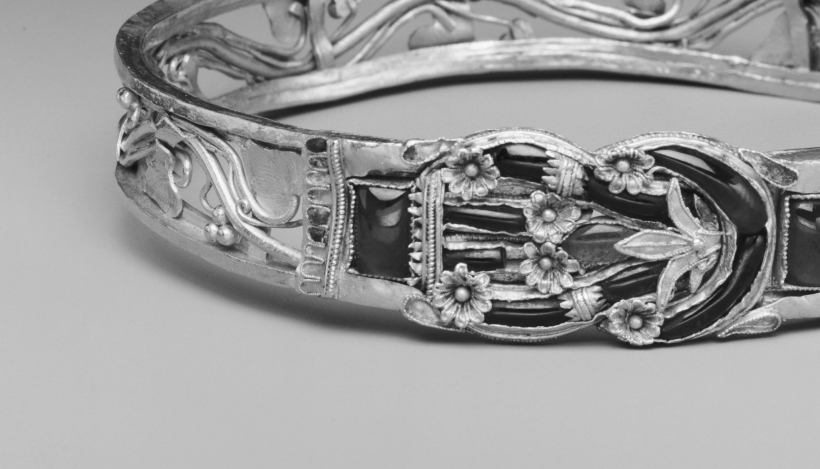
Before dealing with Greek jewellery of the classic period some reference must be made to the primitive and archaic ornaments that preceded it. The period and phase of Greek culture to which the primitive ornaments belong is known widely as “Mycenæan”—a title it owes to the discoveries made at Mycenæ, where in 1876 Schliemann brought to light the famous gold treasure now preserved in the National Museum at Athens.
A characteristic motive of the decoration of these objects is the use of spiral patterns almost identical with those employed on Celtic ornaments. Besides these and other primitive exhibitions of decorative skill, we find representations of naturalistic animal forms, such as cuttlefish, starfish, butterflies, and other creatures.
These are displayed in repoussé patterns worked in low relief. Among the most notable objects are a number of gold crowns usually in the form of elongated oval plates ornamented with fine work chiefly in the shape of rosettes and spirals.
The Goddess Fashion

Mourning jewellery was usually set with pearls, garnets, or more often jet. The last, until a short while ago, was in universal favour, and was fashioned into all sorts of ornaments. It fortunately now meets with but little demand.
The custom of wearing ornaments composed of such sombre and unpleasing material has now to all intents and purposes ceased, though it is carried on to a certain extent in France, where ouvrages en cheveux in the form of bracelets and lockets are still worn as précieux souvenirs de famille.
After the middle of the nineteenth century the use of mourning rings and other memorial jewellery began to die out.
The goddess Fashion, who throughout all ages has waged war on the productions of the goldsmith, has laid a heavier hand on these than on any other forms of personal ornament—a circumstance which accounts for the survival at the present day of a comparatively small proportion of the enormous quantity of objects of this description that must formerly have been produced.
“Of earrings, on the other hand, a considerable number of examples have survived. French and English portraits show at first only a large pear-shaped pearl in each ear.”
In “Jewellery” by H. Clifford Smith
Most families from time to time have consigned to the melting-pot accumulations of these memorials of their predecessors; and those who have been long in the jeweller’s business confess to the hundreds of such relics that they have broken up. It is to be hoped that the present-day revival may lead to the preservation of what remain of these quaint mementoes of our frail mortality.

 devec.nl